BOSTON — Forever chemicals. They’re everywhere — from non-stick pans to seafood to cosmetics.
Researchers say these chemicals, often called PFAS Per-for polyfluoroalkyl substances, can remain in our bodies for years. There are blood tests that can reveal what’s in your system. They’re dubbed forever chemicals because they don’t break down in the environment or in our bodies.
25 Investigates’ Kerry Kavanaugh decided to take a blood test and share her results — and you can decide if it’s worth it for you.
25 Investigates worked with Quest Diagnostics, which offers a PFAS blood panel that screens for nine common forever chemicals for $350. Quest allowed us to film most of my blood test. We went in before the lab opened one January morning to protect patient privacy.
Kavanaugh found the test itself to be quick and painless — just one vial of blood.
Quest says it began offering the PFAS blood test in 2024. Quest says theirs is the first PFAS blood test available as a consumer-initiated test with physician oversight based on recommendations by the National Academies of Sciences, Engineering, and Medicine (NASEM).
She got her results emailed about a week later — and there was the proof: forever chemicals present in her blood.
Kavanaugh turned to Laurel Schaider, PhD, a senior scientist at Silent Spring Institute, to help determine what the results mean. Silent Spring Institute is an independent, nonprofit research organization dedicated to understanding links between everyday chemical exposures and women’s health, with a focus on breast cancer prevention.
“We know there are over 14,000 different PFAs,” Schaider said.
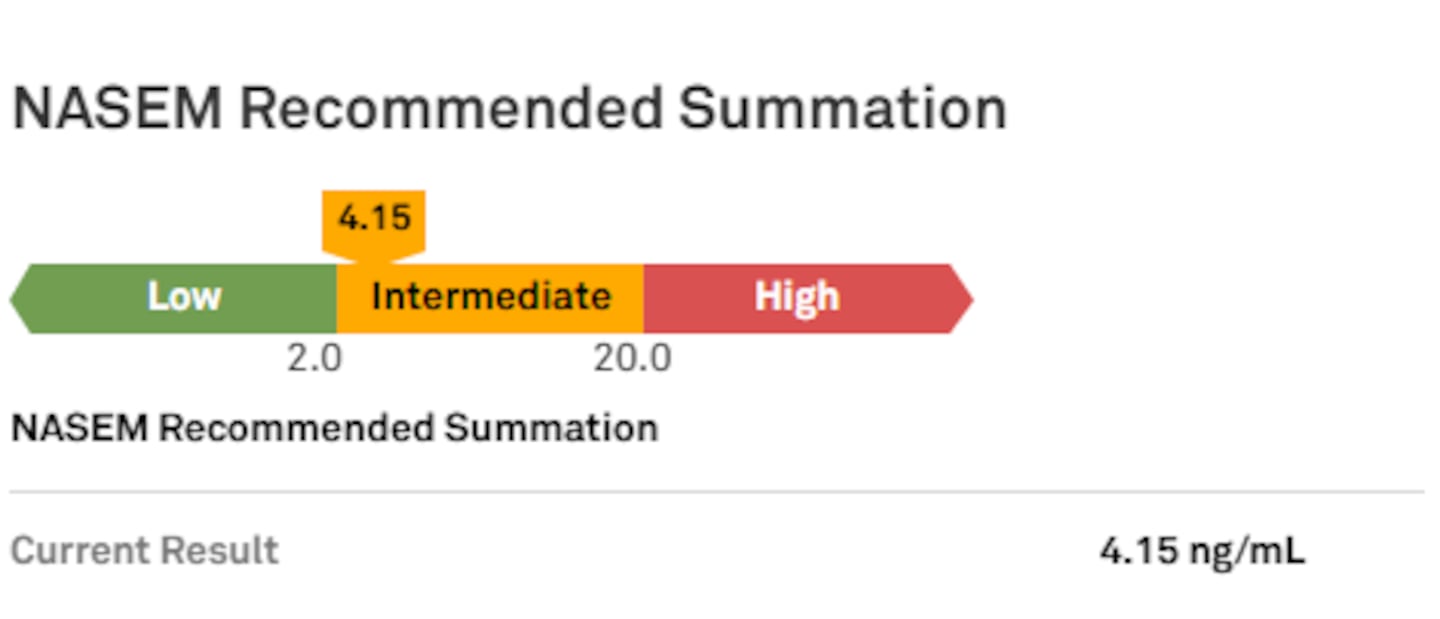
The panel screened several PFAS compounds, including PFHxS, PFOA, PFOS, PFDA, PFUnDA and others. According to Quest, Kavanaugh’s overall results placed PFAS in her blood at 4.15 nanograms per milliliter. Based on a scale created by the NASEM, that puts her at the low end of the intermediate range — typical for someone living in the United States.
“And in the general U.S. population, over 99% of people have detectable levels of PFAS,” Schaider said.
“Should I be worried?” Kavanagh asked Schaider.
“So, like I said, all of us are exposed to PFAS and that in and of itself is concerning,” Schaider said.
She says PFAS can increase cholesterol, are linked to obesity, can affect the immune system and the function of the thyroid, liver and kidneys, and that high levels of exposure have been linked to certain cancers, including testicular and kidney cancer.
Using Silent Spring Institute’s “PFAS Exchange: What’s My Exposure?” tool, Schaider reviewed each individual chemical found in my blood.
Of the nine tested for, MeFOSAA (Methylperfluorooctane sulfonamidoacetic acid) was the only one not detected in Kavanaugh’s blood.
PFHxS (Perfluorohexanesulfonic acid) was present, though at levels lower than the general population.
“We call that PFHxS, and so that is present in some communities from firefighting foams getting into drinking water, but it’s also been used in consumer products as well,” Schaider said.
“Compared to the general population, your level was lower. So, your result was .31, and in the general population the median or middle level is 1.1,” Schaider said.
Most of Kavanaugh’s levels were below average, except for (PFDA Perfluorodecanoic acid) and (PFUnDA Perfluoroundecanoic acid).
“So, these were the original types of PFAS that industry manufactured for putting into products. And they tend to stay in our blood for the longest amount of time,” Schaider said.
“This tends to be more associated with fish consumption,” she added.
But Schaider says this is not a reason to avoid fish consumption.
“So, fish offer a lot of health benefits as well. So, I wouldn’t say to stop eating PFAS because of fish in general,” Schaider said.
“Certainly, it’s important to be aware of any local fish consumption advisories. So, there are some ponds across Massachusetts where there’s been contamination and the State Department of Public Health has issued fish consumption advisories for certain water bodies,” she said. “So, I would say pay attention to those kinds of advisories to make sure you’re not eating fish from a particularly contaminated area.”
DO PFAS LEVELS IN THE BODY EVER GO DOWN?
Yes, Schaider said.
“We do know that once we stop being exposed to PFAS, that the levels in our body will go down,” she said.
Asked what to do next, Schaider said, “To the extent possible, I do think it’s prudent to try to reduce our exposures to PFAS where we can.”
There are no medically proven treatments for removing PFAS from your blood, and it’s not yet clear if that is necessary. Right now, Schaider says prevention is key.
That starts with examining consumer products. Schaider says to be aware of risks tied to certain non-stick cookware, water-resistant clothing, stain-resistant furniture or carpets, cosmetics and even some types of dental floss.
When it comes to consumer goods, Schaider says there are some things people can do to educate themselves, but she sees PFAS exposure as a systemic issue.
“A lot of people think that the government is keeping an eye out and making sure that there aren’t toxic chemicals in our products. And unfortunately, that’s not the case,” Schaider said.
Silent Spring Institute has also created a Detox Me app to help consumers navigate potential exposures.
Water supply contamination is the biggest concern, along with occupational exposure to things like firefighting foam and even ski wax.
“There’s a lot of concern about firefighter exposures both from certain firefighting foam called AFFF, especially used at airports and fire training academies on military bases. So, there’s some concern that there can be exposure from the firefighting foam, and even from the protective gear that firefighters wear that has a protective layer that contains PFAS,” Schaider said.
“Even ski technicians or ski waxers can be exposed to PFAS because some ski waxes have high PFAS, so there’s been some studies showing elevated occupational exposures for ski wax technicians,” she added.
PFAS blood test, the issue of access
There are laboratory blood tests and at-home tests available. 25 Investigates found them ranging from roughly $300-$600. Massachusetts does not require insurance coverage for these blood tests. Maine and New Hampshire are the only states that do.
Schaider said the tests should be more accessible, providing people with a valuable baseline — and the Massachusetts Medical Society (MMS) agrees.
On their website, the MMS says, “We maintain that PFAS blood testing should be covered by insurance, as lead testing is, so that patients who already have difficulty finding clinical preventive services for reasons of race, age, and other social and demographic factors have equal opportunity to access PFAS testing and the accompanying exposure reduction counseling.”
“No one should be doing this and be alarmed, but it’s more to be informed, right?” Kavanaugh asked.
“Absolutely,” Schaider said. “So for people who likely have had high exposures, maybe they live in a community where the water’s been contaminated, or they’ve eaten contaminated fish, or maybe they’ve had some on-the-job exposures.
“There’s a lot of concern about firefighter exposures both from certain firefighting foam called AFFF 9 (Aqueous Film-Forming Foam), especially used at airports and fire training academies on military bases,” she said. “So, for people who’ve had high exposures, the tool or getting their blood tested can provide important information. They can get a sense of how high their exposures are.”
Quest officials agree on the highest benefit for those who are most at risk.
“Not everyone needs a PFAS blood test, but for individuals who may have a high risk, Quest provides multiple opportunities to understand their exposure based on the latest science and advanced lab technologies,” said Jack Kain, PharmD, director and medical science liaison of Drug Monitoring and Toxicology at Quest Diagnostics.
This is a developing story. Check back for updates as more information becomes available.
Download the FREE Boston 25 News app for breaking news alerts.
Follow Boston 25 News on Facebook and Twitter. | Watch Boston 25 News NOW
©2026 Cox Media Group
/cloudfront-us-east-1.images.arcpublishing.com/cmg/7QOJU3BNCJERBNKJC5LWTBYFLU.png)


