
BOSTON — Enough time has elapsed now following Thanksgiving celebrations that state health officials can confirm a sharp increase in COVID-19 infections is tied to those gatherings.
Even with extensive warning from both Governor Charlie Baker and other local leaders, people in Massachusetts still chose to hold gatherings on Thanksgiving, which only worsened the COVID-19 scenario in the commonwealth.
Exactly two weeks after Thanksgiving, state officials reported 158 cities and towns are now considered at “high-risk” for COVID-19, a 47-community increase from last week. This week, 92 communities are considered at moderate risk for the virus, compared to the 139 from the previous week. Data suggests that many towns that had been considered “yellow zones” have shifted into the “red zone”.
The news comes just one day after Baker unveiled the state’s COVID-19 vaccination plan once a vaccine is approved by the FDA for nationwide distribution. Also on Thursday, one of the FDA’s 47 advisory panels endorsed Pfizer’s COVID-19 shot, a major step toward a vaccination campaign against the pandemic.
The average number of cases among red towns this week is 53.18 while the average positivity rate among these communities is 7.36%. For communities in yellow zones, the average number of cases is 27.67, while the average positivity rate is 3.45%.
New COVID-19 health data released by the Massachusetts Department of Public Health on Thursday, Dec. 3 highlighted the significant recent increase in COVID-19 cases and infection rates throughout the state.
This week, the state of Massachusetts as a whole is considered to be a “red zone” as cases continue to climb during the holiday season. The jump in cases prompted Baker to roll back the state’s reopening plan back to Phase 3, Step 1 which limits the capacity for retail and gyms and limits the number of people at a restaurant table to six instead of 10, among other changes.
The risk measurement system for cities and towns in Massachusetts raises the cases required per 100,000 threshold for the “red” designation while adding variables for community size and positive test rate.
The system breaks down cities and towns into three categories based on population: those with fewer than 10,000 residents, those with between 10,000 and 50,000 residents, and those with more than 50,000 residents.
The criteria for labeling towns has changed to include gray, along with the existing red, yellow and green designations of how prevalent cases of the virus are in any given city or town.
Towns and cities in red this week include:
Abington, Acushnet, Agawam, Amesbury, Andover, Ashland, Attleboro, Auburn, Avon, Ayer, Barnstable, Bellingham, Berkley, Billerica, Blackstone, Boxford, Boylston, Bridgewater, Brockton, Burlington, Carver, Charlton, Chelmsford, Chelsea, Chicopee, Clinton, Concord, Danvers, Dartmouth, Dighton, Douglas, Dover, Dracut, Dudley, East Bridgewater, Edgartown, Everett, Fairhaven, Fall River, Fitchburg, Framingham, Freetown, Gardner, Georgetown, Gloucester, Grafton, Granby, Groveland, Halifax, Hamilton, Hanover, Hanson, Harwich, Haverhill, Holbrook, Holden, Holyoke, Hopedale, Hudson, Lakeville, Lancaster, Lawrence, Leicester, Lenox, Leominster, Littleton, Lowell, Ludlow, Lunenburg, Lynn, Lynnfield, Malden, Manchester, Mansfield, Marion, Marlborough, Marshfield, Mattapoisett, Melrose, Mendon, Merrimac, Methuen, Middleborough, Middleton, Milford, Millbury, Millis, Montague, Nantucket, New Bedford, Norfolk, North Andover, North Attleborough, North Brookfield, Northborough, Norton, Norwood, Oxford, Palmer, Peabody, Pembroke, Pittsfield, Plainville, Plymouth, Quincy, Randolph, Raynham, Rehoboth, Revere, Rochester, Rockland, Rowley, Rutland, Salem, Salisbury, Saugus, Seekonk, Shirley, Shrewsbury, Somerset, Southampton, Southborough, Southbridge, Southwick, Spencer, Springfield, Sterling, Stoneham, Stoughton, Sturbridge, Sutton, Swansea, Taunton, Tewksbury, Topsfield, Townsend, Tyngsborough, Upton, Uxbridge, Wakefield, Walpole, Wareham, Webster, West Boylston, West Bridgewater, West Springfield, Westfield, Westford, Westminster, Westport, Weymouth, Whitman, Wilbraham, Wilmington, Winthrop, Woburn, Worcester and Yarmouth
Communities that are considered at moderate risk are:
Acton, Adams, Amherst, Arlington, Ashburnham, Athol, Barre, Bedford, Belchertown, Belmont, Berlin, Beverly, Boston, Bourne, Braintree, Brewster, Brookline, Cambridge, Canton, Cohasset, Dalton, Dedham, Deerfield, Dennis, Dunstable, Duxbury, East Longmeadow, Easthampton, Easton, Falmouth, Foxborough, Franklin, Great Barrington, Greenfield, Groton, Hampden, Harvard, Hingham, Holliston, Hopkinton, Hull, Ipswich, Kingston, Lee, Lexington, Longmeadow, Marblehead, Mashpee, Maynard, Medfield, Medford, Medway, Milton, Monson, Natick, Needham, Newbury, Newburyport, Newton, North Adams, North Reading, Northampton, Northbridge, Norwell, Oak Bluffs, Paxton, Pepperell, Princeton, Reading, Sandwich, Scituate, Sharon, Somerville, South Hadley, Stow, Sudbury, Swampscott, Templeton, Tisbury, Waltham, ,Ware, Watertown, Wayland, Wellesley, West Brookfield, West Newbury, Westborough, Weston, Westwood, Winchendon, Winchester and Wrentham.
As of Dec. 9, a total of 126,652 people have undergone a quarantine period (but are no longer subject to quarantining) and a total of 12,715 people are currently being monitored and undergoing quarantine. So far, 139,367 Massachusetts residents in total have been subject to quarantine since the outbreak began locally.
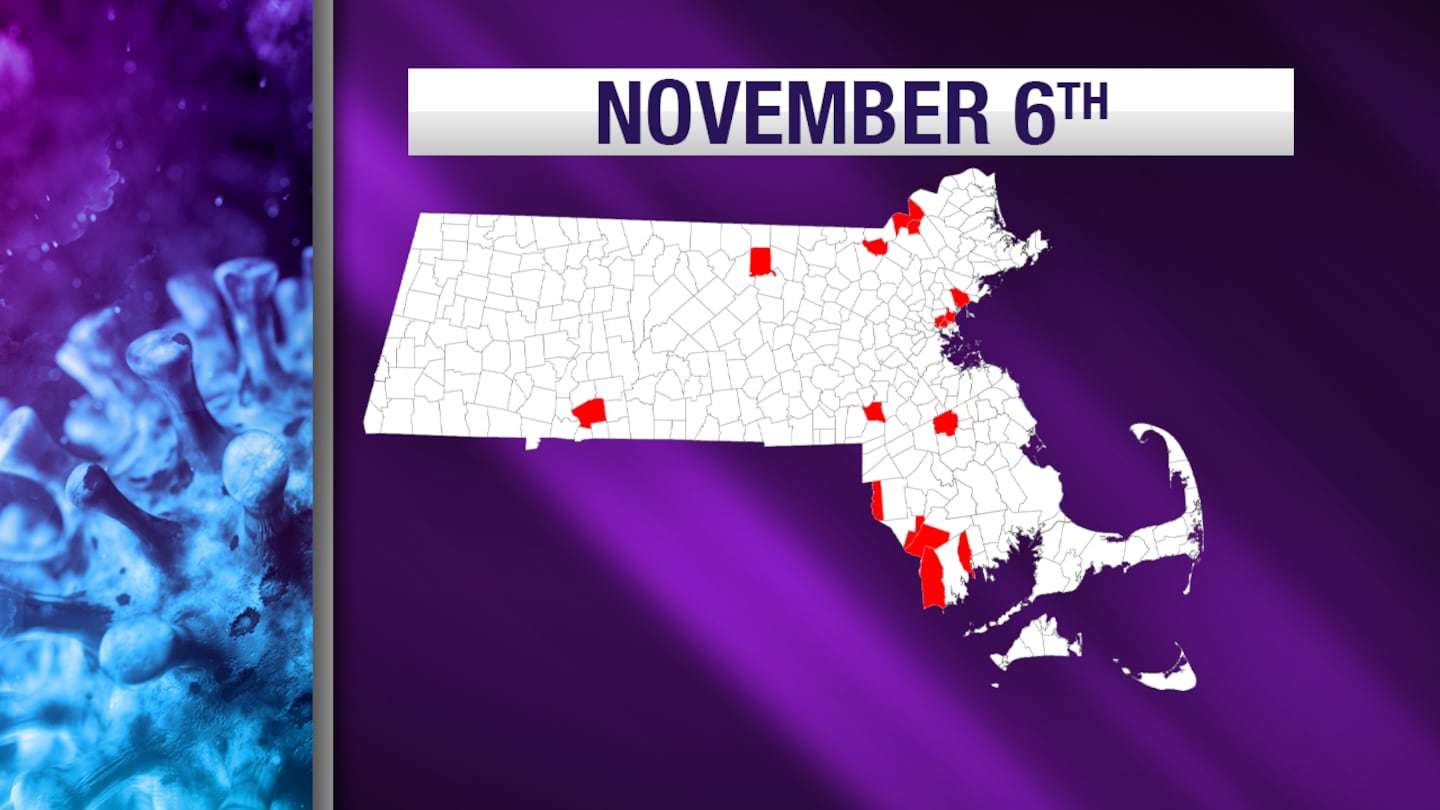
The increase in cases and hospitalizations this week reflects the concern local leaders had with too many Thanksgiving gatherings happening across the state. On a daily basis, the state has seen an increase in new cases and deaths among people with confirmed cases of the virus. Over one month ago, on Nov. 6, there were far fewer communities in the red across Massachusetts, as seen in the map shown above.
Even one week makes a huge difference. While cases were growing even before the holiday, a significant spike within one to two weeks of Thanksgiving showed just how quickly the novel coronavirus can spread. Baker and his COVID-19 prevention team have, time and time again, reiterated how important it is that people only socialize with members of their households, or their “bubble.”
>>>MORE: Nantucket shifting to remote-learning for rest of week after spike in virus cases
According to the new town-by-town data, the average age of COVID-19 cases is 39, but the average age of cases that were hospitalized was 69. The average age of deaths among confirmed COVID-19 cases is 82.
Across the state as a whole, there have now been a total of 264,454 confirmed COVID-19 cases, including 5,130 newly reported Thursday, Dec. 10. An additional 41 new deaths bring the death toll to 10,963 people who died with confirmed cases of COVID-19.
>>>MORE: Criminal charges filed in connection with drowning death of teen in DCF custody
The state estimates there are about 63,362 active cases of the virus in Massachusetts.
Since last week, 656 new COVID-19 cases have been reported among higher education testing since last week, bringing the total number of confirmed coronavirus cases associated with higher education to 5,119.
Download the free Boston 25 News app for up-to-the-minute push alerts
>> Complete local and national coronavirus coverage here
RESOURCES:
- Complete local and national coronavirus coverage here
- Follow us on Facebook and Twitter | Watch Boston 25 NOW
/cloudfront-us-east-1.images.arcpublishing.com/cmg/7QOJU3BNCJERBNKJC5LWTBYFLU.png)


