
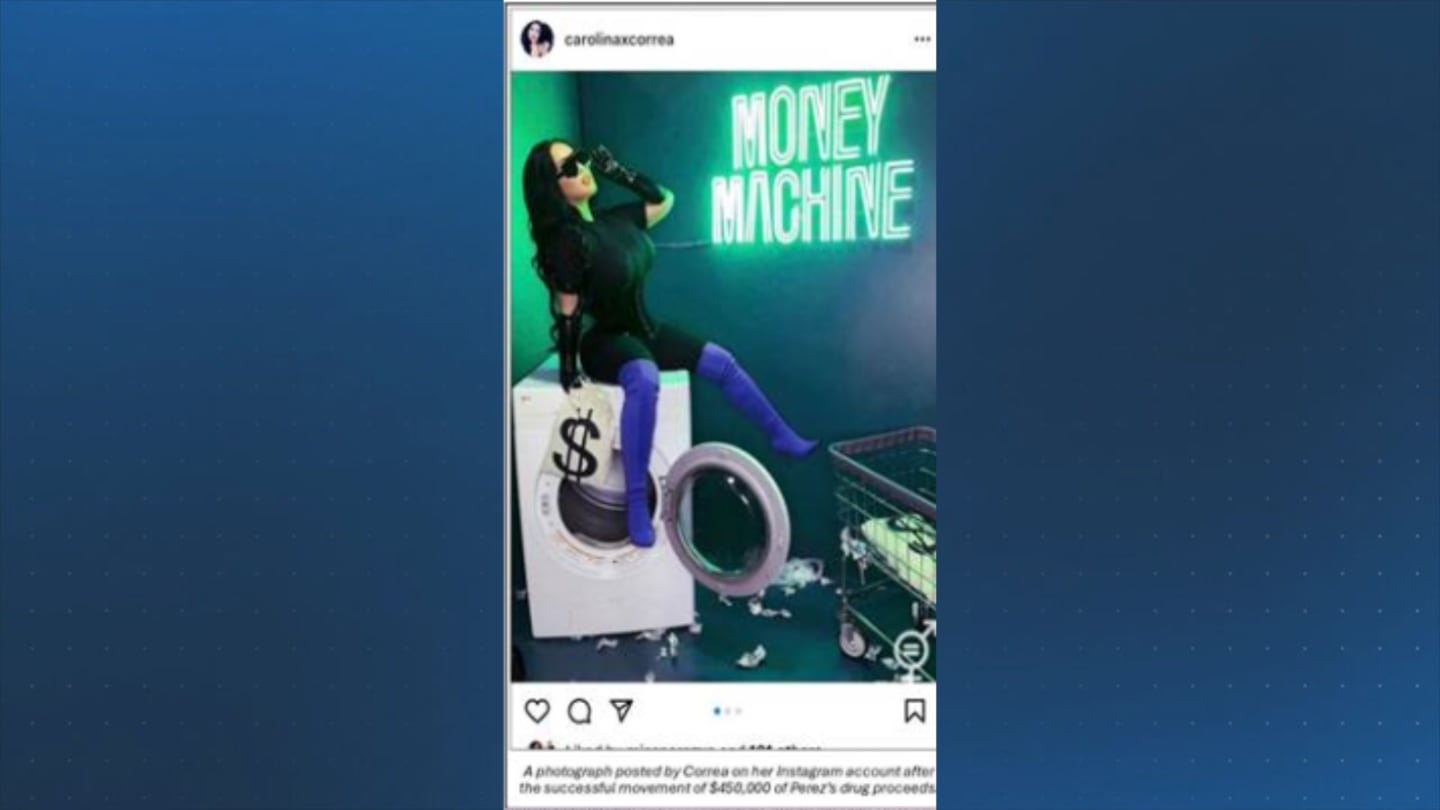
BOSTON — A Rhode Island businesswoman who posted a racy photo on Instagram showing a woman perched on top of a laundry machine and the words “Money machine” has been sentenced to federal prison for money laundering, the U.S. Attorney said.
Carolina Correa, 35, of Cranston, Rhode Island, once named as a national teen spokeswoman for the Boys & Girls Club of America, was sentenced Wednesday to 42 months in prison to be followed by five years of supervised release, U.S. Attorney Leah Foley said in a statement on Friday. U.S. District Court Judge Leo Sorokin handed down her sentence.
Correa was also ordered to pay a $150,000 fine and forfeiture in the amount of $350,000.
In July 2025, Correa pleaded guilty to one count of money laundering conspiracy.
A racy Instagram post was among the evidence prosecutors used in the case against Correa, an entrepreneur, real estate owner, and fundraiser, Foley said.
The brazen post shows a caricature of a woman wearing sunglasses, purple stiletto boots, and black leggings sitting perched on a laundry machine. The woman is purportedly holding a bag with the “$” symbol. On the wall next to her is a neon sign with the words, “Money machine.”
Correa led a sophisticated multi-state scheme to launder $450,000 in fentanyl trafficking proceeds derived by her then-boyfriend, Jasdrual Perez, Foley said.
Correa has ties to Massachusetts.
A former student at what is now Assumption University in Worcester, Correa was named Boys & Girls Club of America’s 2009-10 National Youth of the Year, according to a 2009 article in the Telegram & Gazette. The psychology major from Pawtucket, Rhode Island, originally from Colombia, was the first Hispanic female to receive the title.
“Ms. Correa will serve as the national teen spokeswoman for 4.5 million youths and receive $26,000 in college scholarships from the program’s founding sponsor, Reader’s Digest Foundation,” the 2009 article states.
“Now a member of the Assumption women’s swim team, Ms. Correa was named most valuable swimmer three times in high school,” the article states, “and created a basic swimming skills program for inner-city youth, among other community service projects.”
In December 2024, her former boyfriend, Jasdrual Perez, was sentenced to 22.5 years in prison for his role as the leader of a large-scale fentanyl trafficking conspiracy responsible for manufacturing and distributing millions of fentanyl pills made to look like oxycodone and Percocet.
In late 2021 to early 2022, Perez “enlisted his financially-savvy girlfriend Correa to assist him in concealing his drug proceeds,” prosecutors said.
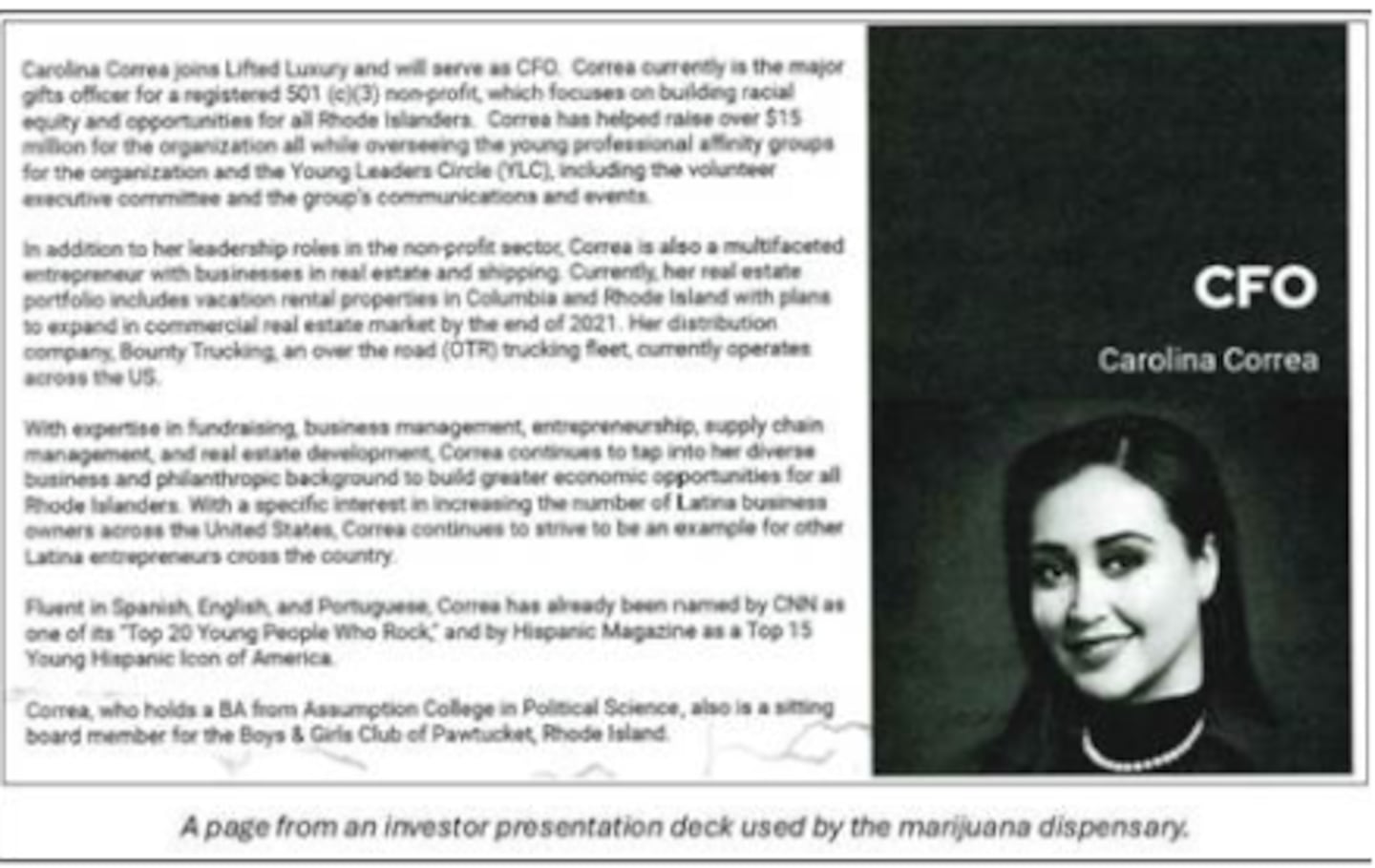
Correa contacted a friend who was opening a marijuana dispensary in Massachusetts and seeking investors, prosecutors said. Correa agreed to seek out investors in the dispensary, and in exchange, she would get an ownership stake and the title of CFO of the marijuana dispensary.
In January 2022, Correa indicated that she had found “investors” in the marijuana dispensary. Those “investors” included a real estate investor based in North Carolina with whom Correa had a long-time personal, not professional, relationship, as well as his associate.
Shortly thereafter, Correa enlisted a friend to drive $350,000 in Perez’s drug proceeds from Rhode Island to Correa’s “investors” in North Carolina, prosecutors said.
Financial records showed that the North Carolina “investors” then wired $350,000 in two transactions, from two separate business accounts, in the amount of $250,000 and $200,000, to a bank account for an attorney for the marijuana dispensary, prosecutors said. Those funds were then transferred from the attorney’s account to the marijuana dispensary’s business account.
To further create an appearance of legitimacy for the concealed drug proceeds, Correa used her work email address to communicate with the North Carolina “investors.” Prosecutors said she drafted sham loan paperwork and promissory notes for her, the CEO of the marijuana dispensary and the North Carolina “investors” to sign to conceal the true source of the funds.
Correa and Perez also facilitated, and bank records confirmed, the laundering of an additional $100,000 of Perez’s drug proceeds into the marijuana dispensary’s bank account, prosecutors said, through the business bank account of a real estate investment company of one of Perez’s Rhode Island-based friends.
“Correa used her professional reputation and public image to appear that she was legitimately securing ‘investors’ in the marijuana dispensary while, simultaneously, in intercepted communications, she regularly described the hustle to ‘clean’ Perez’s drug money for her own financial benefit through various financial and real estate transactions,” prosecutors said.
After successfully moving $450,000 of Perez’s drug proceeds, Correa posted the photograph with the woman on the laundry machine to her Instagram account, prosecutors said.
“Money launderers protect and strengthen an industry – the drug trafficking industry – that directly harms millions of people,“ Foley said.
”By making drug profits usable, launderers allow drug trafficking organizations to operate like legitimate businesses. To say that money laundering is a victimless crime ignores the reality of the interconnected relationship between launderers and traffickers,“ Foley said.
“As a fentanyl trafficker’s business expands, so too do the rates of drug use, addiction and overdose. Ms. Correa thought she could outsmart the system and law enforcement while she was laundering at least half a million dollars in drug proceeds,” Foley said.
“This case should serve as a warning to others that our efforts to curb drug addiction doesn’t just involve prosecuting drug dealers, it also involves arresting their financial partners in the trafficking conspiracy,” the U.S. Attorney said.
Special Agent in Charge Jarod Forget, New England Field Division, echoed her words.
“This case shows that fentanyl trafficking is not limited to street-level dealers,” Forget said. “Ms. Correa used her business and fundraising activities to disguise and move hundreds of thousands of dollars in drug proceeds, directly supporting a trafficking operation that fuels addiction and death in our communities. The DEA will hold accountable anyone who profits from this poison, no matter how they try to hide it.”
Thomas Demeo, Special Agent in Charge of Internal Revenue Service, Criminal Investigation, Boston Field Office, said his team worked alongside law enforcement partners to bring Correa to justice.
“The capability to launder illegal drug profits is as important and essential to drug traffickers as the very profit made from the distribution of their illegal drugs,” Demeo said in a statement. “Without these ill-gotten gains being ‘cleaned’, the traffickers cannot ‘legitimately’ finance their illicit business or spend the money.”
“As the role of IRS-CI in narcotics investigations is to follow the money, we are highly skilled at financially disrupting and dismantling drug trafficking organizations,” Demeo said.
This is a developing story. Check back for updates as more information becomes available.
Download the FREE Boston 25 News app for breaking news alerts.
Follow Boston 25 News on Facebook and Twitter. | Watch Boston 25 News NOW
©2026 Cox Media Group
/cloudfront-us-east-1.images.arcpublishing.com/cmg/7QOJU3BNCJERBNKJC5LWTBYFLU.png)


