You know the expression — don’t judge a book by its cover? Local authors say it’s never been truer.
They’re warning readers about copycat books created with artificial intelligence and sold on Amazon — books that look strikingly similar to theirs, at least until you open them.
For a writer, publishing a first book is a major milestone. Liane Moccia, a registered herbalist and author from Andover, published her first book in September 2025. It was the result of two and a half years of work, inspired by a deep personal struggle.
“I became an herbalist and specialize in fertility because of my own fertility challenges. And I just want people to know that they’re not alone in this journey,” Moccia said.
She was thrilled when the time came to finally share her journey through her book sold in stores and online.
“And as a new author, I was so excited, and I don’t think I’m alone in this. I would check Amazon almost every day to see the rating, the ranking, to see where it was ranking in its categories,” she said.
Within weeks of checking the status of her book, she discovered something she never expected.
“I entered the title, I hit enter, and in addition to my book were two other books with the same exact title — that were not written by me,” Moccia said.
The descriptions read a lot like hers too. When she researched the listed authors, she couldn’t find much information. So, she ordered the books herself.
“There’s a lot of weird spaces, the margins are really large,” Moccia said showing the books to 25 Investigates’ Kerry Kavanaugh. Some pages were blank.
Moccia noted how one chapter directed readers to a later chapter that didn’t exist.
“It felt like AI-written content,” Moccia said.
When compared to Moccia’s book, the differences were stark. Moccia’s includes an author bio and early praise on the back cover. The apparent AI-generated versions did not. The back covers were blank, except for a barcode.
Moccia’s experience as an author selling books on Amazon isn’t isolated.
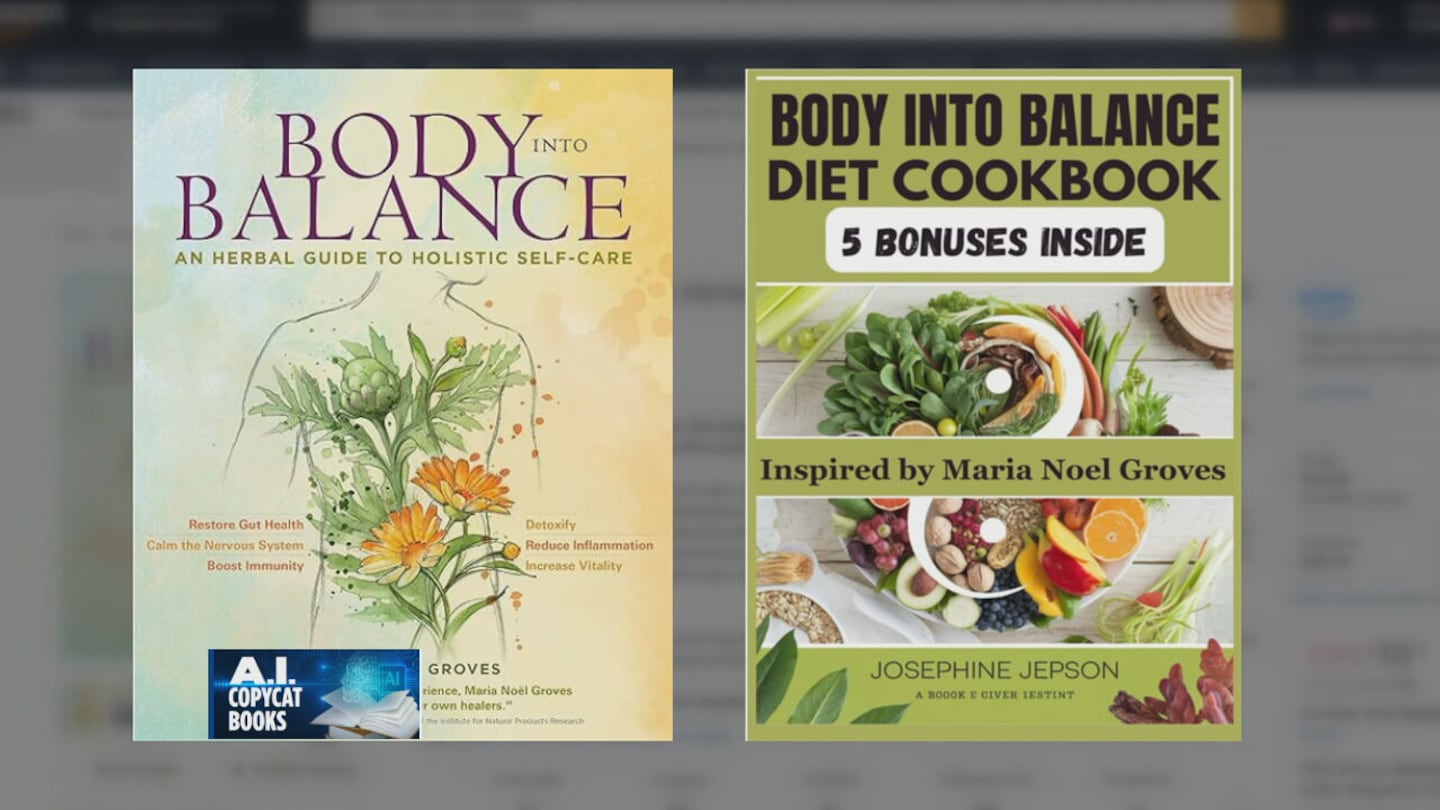
“They put my name on the cover, but they don’t say I’m the author,” said Maria Noël Groves.
Groves is a clinical herbalist from New Hampshire who has published books sold on Amazon for more than a decade. She recently discovered knockoff books that closely resemble her work.
One of Groves’ books is titled Body Into Balance: An Herbal Guide to Holistic Self-Care. A different book — Body Into Balance Diet Cookbook — Inspired by Maria Noël Groves — appeared for sale online, but that is not Groves work. She did not authorize use of her name either.
“I don’t love that it could affect my own book sales, but that’s really not my big concern. My big concern is the safety of the public,” Groves said.
Moccia said she found potentially dangerous misinformation in the copycat books.
“I found several instances of herbs that I would never recommend a person take when they’re trying to conceive, because they’re herbs that are contraindicated in pregnancy. Some of them are teratogens, which can cause known birth defects in children. Others can bring on bleeding or miscarriage,” she said.
25 Investigates asked Amazon about the apparent AI-generated books being sold on its platform. The company declined an interview. In a written statement, a spokesperson said:
“We have content guidelines governing which books can be listed for sale, and we have proactive and reactive methods that help us detect content that violates our guidelines, whether AI-generated or not. We invest significant time and resources to ensure our guidelines are followed, and remove books that do not adhere to those guidelines. We aim to provide the best possible shopping, reading, and publishing experience, and we are constantly evaluating developments that impact that experience.”
The issue is a growing one, according to Sam Ransbotham, a professor of analytics at Boston College.
“Oh, it’s a big deal and it’s everywhere,” Ransbotham said.
Ransbotham is also a co-host of the podcast Me, Myself, and AI. He said artificial intelligence makes it easier to mass-produce content — including low-quality or deceptive material.
“Behind that there is some nefarious bad actor saying, hey, I will co-opt this person’s ideas and produce them as my own,” he said.
When asked what responsibility platforms like Amazon have, Ransbotham said consumer trust is critical.
“Amazon has every incentive to make your experience good because if they start to have a reputation for having junk products, then no one will go to that platform and buy it,” he said.
Moccia said the discovery was both emotional and unsettling.
“I was really angry at first. And then I also felt really worried that people would mistake my book for one of these,” she said.
Moccia shared advice for online book buyers:
- Research the author and look for a website or social media presence
- Shop at brick-and-mortar bookstores that typically buy directly from publishers
- Leave online reviews for authentic authors and flag suspected fakes
“Raising awareness. A lot of people think, if something’s on Amazon, that it’s been vetted, and that’s just not true,” Moccia said.
Boston 25 News checked and confirmed the copycat books Moccia purchased with titles like hers are no longer available for sale on Amazon.
Amazon customers can use the “Report an Issue” section at the bottom of a book’s detail page to flag content they believe is inappropriate for sale.
Download the FREE Boston 25 News app for breaking news alerts.
Follow Boston 25 News on Facebook and Twitter. | Watch Boston 25 News NOW
©2026 Cox Media Group
/cloudfront-us-east-1.images.arcpublishing.com/cmg/7QOJU3BNCJERBNKJC5LWTBYFLU.png)


