
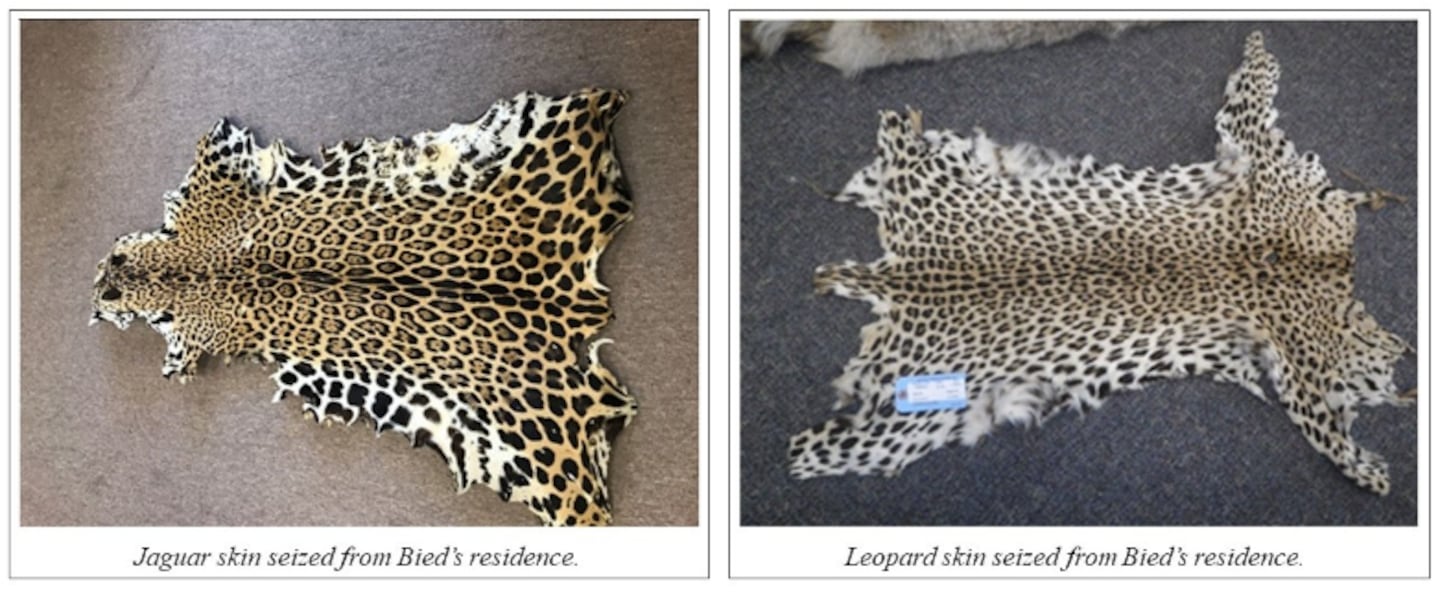
BOSTON — A Massachusetts man has been sentenced to federal prison for trafficking into the country more than 100 animal parts from endangered and protected wildlife, including African lion skulls, Jaguar skins, and Polar Bear skulls, the U.S. Attorney said.
Adam Bied, 40, of Reading, was sentenced to eight months in prison, to be followed by two years of supervised release, U.S. Attorney Leah Foley said in a statement on Thursday. U.S. Senior District Court Judge F. Dennis Saylor IV handed down his sentence.
Prosecutors said some of the wildlife whose animal parts he trafficked were slaughtered at Bied’s direction.
Bied was also ordered to pay a $75,000 fine to fund wildlife enforcement efforts.
Bied pleaded guilty in January to two counts of conspiracy to smuggle goods into the United States, specifically, illegally imported wildlife parts, and two counts of violating the Lacey Act, which prohibits trafficking in wildlife.
Prosecutors said Bied illegally imported wildlife that was protected by the Endangered Species Act and the Convention on International Trade in Endangered Species of Wild Fauna and Flora.
None of the wildlife Bied imported was declared as required by law. Bied was charged in June 2024.
“Trafficking in the remains of endangered and protected animals is not a collector’s hobby – it is a crime that fuels the exploitation of vulnerable species around the world,” Foley said.
“As the Department of Justice has made clear, protecting animal welfare and enforcing our wildlife laws is a priority. This defendant knowingly smuggled and profited from the killing of protected animals – some of which were slaughtered at his direction – undermining global conservation efforts,“ Foley said.
“Today’s sentence holds him accountable and sends a clear message: those who traffic in wildlife will be investigated and prosecuted to the fullest extent of the law,” Foley said.
Doug Ault, assistant director of the U.S. Fish and Wildlife Service, Office of Law Enforcement, echoed her comments.
“Our agency works diligently to combat the illegal international trafficking of wildlife parts due to its devastating effect on a wide variety of vulnerable species,” Ault said. “In their quest for quick profit, wildlife smugglers push critically endangered animals toward the edge of extinction and undermine global conservation efforts. Halting this illegal trade remains one of our highest priorities and together with the Department of Justice, we will bring those responsible to justice.”
Prosecutors said starting in January 2018 through June 2021, Bied bought, sold, and traded in wildlife parts and products from threatened and endangered species, knowing that many of the transactions violated U.S. laws and regulations, including the ESA and the Lacey Act.
Bied also knowingly failed to declare the wildlife to the U.S. Fish and Wildlife Service upon importation into the United States.
Specifically, prosecutors said Bied placed orders with people in Cameroon and Indonesia who were in the businesses of killing and acquiring wildlife, including endangered and protected species, received the parts in the U.S. unlawfully and then resold or traded the wildlife to customers in the United States.
In text messages, Bied and a co-conspirator in Cameroon, a person Bied knew to be a poacher of native species, discussed hunting and killing wildlife, prosecutors said.
For example, in June 2018, when the co-conspirator told Bied that he was unable to obtain bullets for hunting wildlife due to the ongoing civil war, Bied offered to send him bullets.
After the co-conspirator said he could go to jail if he is caught receiving ammunition during the ongoing civil war, Bied offered to send him money for bullets in exchange for skulls, including, as they discussed, chimpanzee skulls, prosecutors said.
Bied also requested a gorilla skull.
Both gorillas and chimpanzees are endangered, and most gorilla species are critically endangered. Prosecutors said Bied also sought to purchase skulls from elephants, lions, hippos, and other “rare” and “large animals.”
Bied repeatedly instructed the co-conspirator not to send him skulls with bullet holes, writing “stop sending me skulls with holes” and “Just send me a lot of big skulls. Also no skulls with bullet holes,” prosecutors said.
In various messages to the co-conspirator, Bied referred to his customers, advising him, “I need rare things for my customers.”
Prosecutors said Bied was aware of the laws protecting wildlife and governing wildlife importation and that it was illegal to trade in endangered and protected species.
For example, on Dec. 26, 2019, Bied took photographs of an educational exhibit at a zoo about illegal wildlife trafficking, which prominently featured pangolins as the “most heavily trafficked wild mammal.” Later that day, Bied texted the co-conspirator, “I’d like to buy the pangolin skull – I’d like to buy this pangolin still.” All pangolin subspecies are protected wildlife.
Bied and another conspirator in Indonesia exchanged electronic messages about the acquisition, purchase, and sale of wildlife and protected wildlife, prosecutors said.
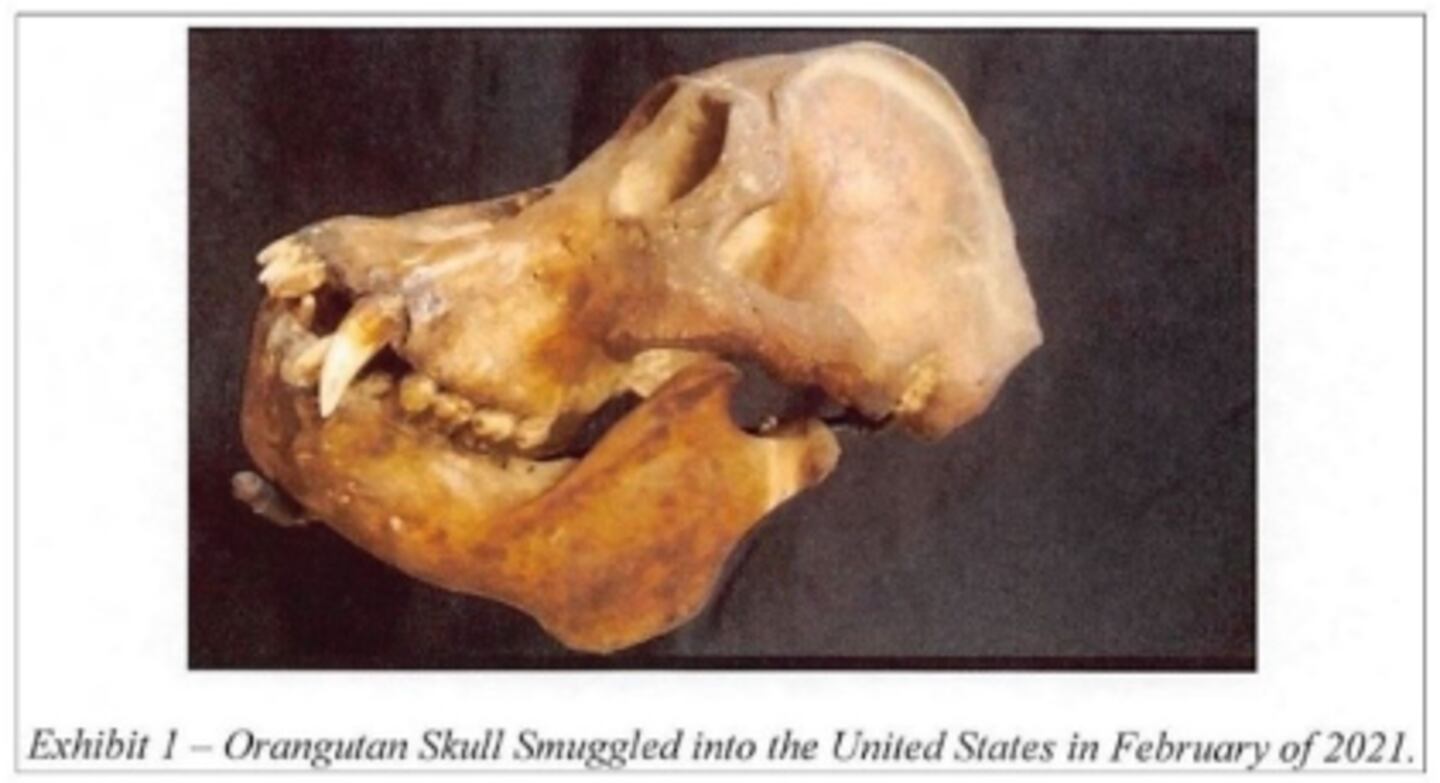
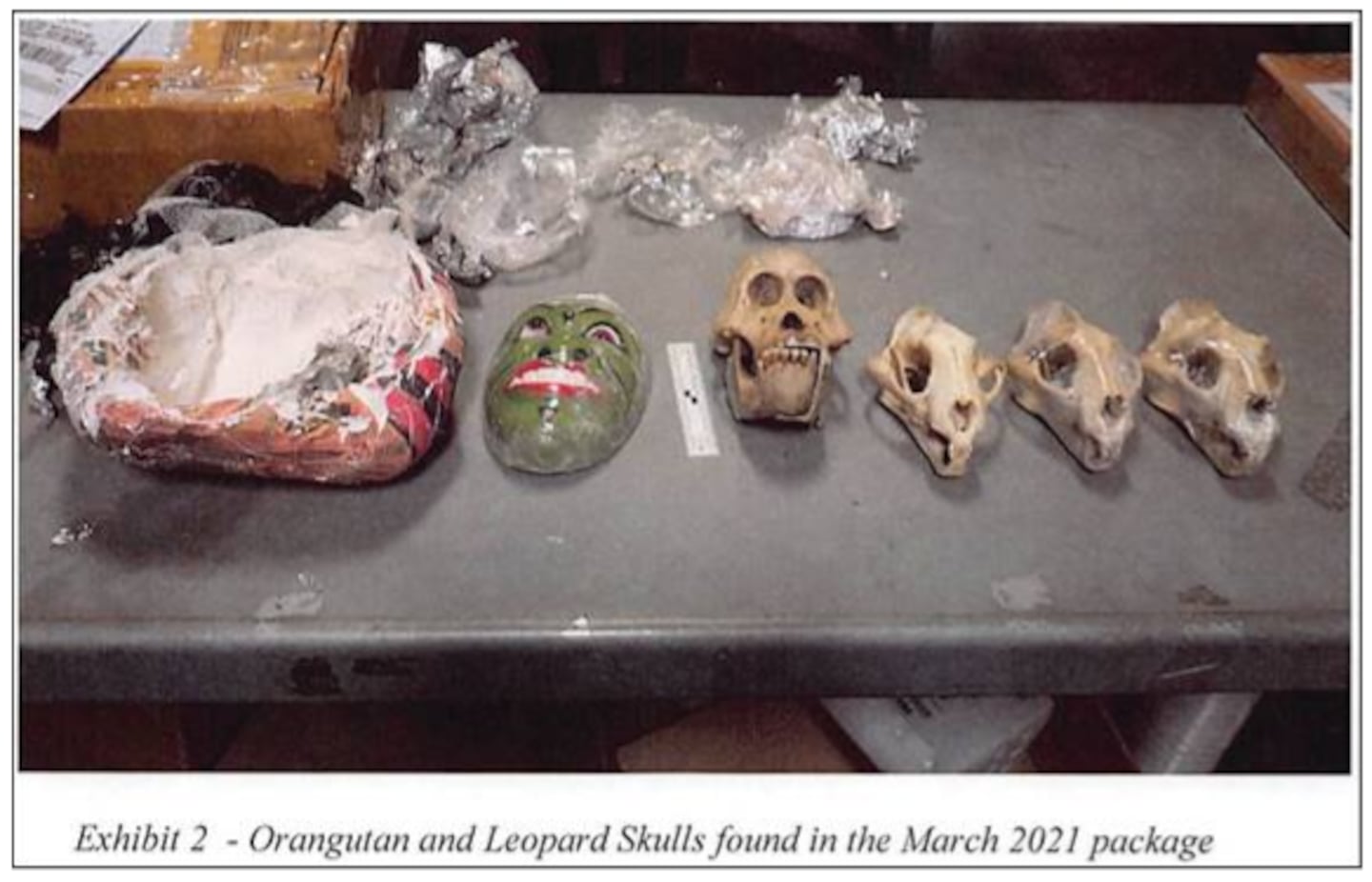
Among other wildlife, Bied purchased multiple orangutans and Javan leopard skulls from the co-conspirator. Both species are critically endangered.
Bied later sold two illegally imported leopard skulls to an undercover federal agent, prosecutors said.
During the negotiations over one skull, Bied lied about its origin, falsely claiming to the agent that the leopard skull was at least 60 years old, that he had purchased it at an auction, and that he believed the sale of this skull to be legal, prosecutors said.
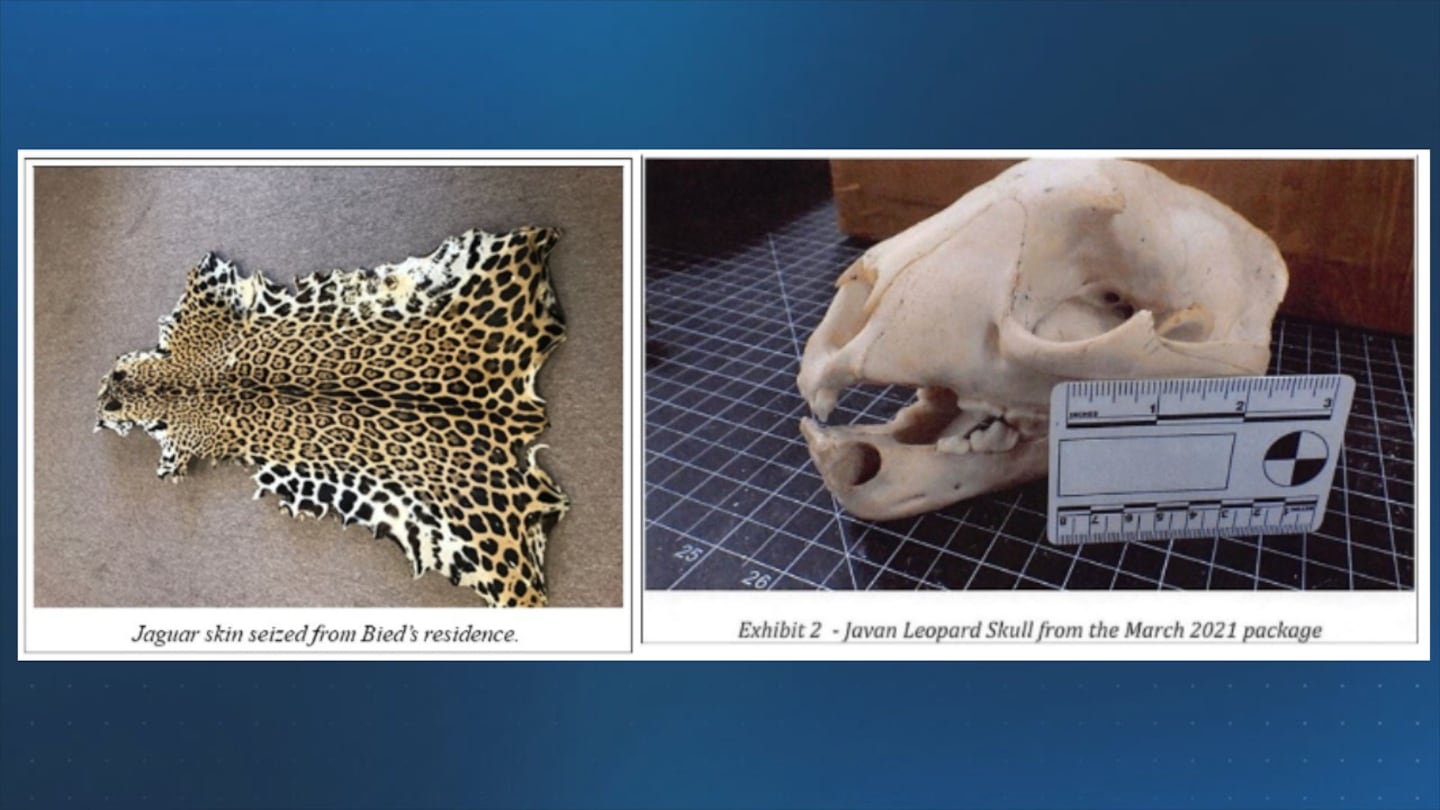
In fact, the skull had been recently illegally imported from Indonesia.
Bied neither sought nor obtained the necessary import/export licenses or permits before importing these items, nor did he declare the wildlife to the USFWS upon import as required, Foley said.
Instead, Bied and his co-conspirators took steps to conceal the wildlife parts from U.S. authorities by falsely labeling them as “decorative masks” and “rodents,” among other things, Foley said.
Bied unlawfully imported skulls from the following wildlife species, among others: baboon, chimpanzee, pangolin, orangutan, and leopard.
Bied has consented to the civil forfeiture of over 100 wildlife parts from endangered, threatened, or protected species seized by authorities in July 2021 from Bied’s home, storage unit, and vehicle.
The wildlife parts identified in the civil forfeiture complaint include:
- Orangutan skulls
- Tiger skulls
- Leopard skin, skulls and a claw
- Jaguar skin and skull
- African lion skulls
- Polar bear skull
- Narwhal tusk
- Otter skeleton
- Harp seal skull
- Pangolin skull
- South American fur seal skull
- Elephant seal skull
- Babirusa skulls
- Mandrillus skulls
- Wallaby skull
- Jackal skull
Federal wildlife statutes and regulations prohibit international and illegal trade in vulnerable wildlife species.
The Endangered Species Act, the Lacey Act, and CITES, as well as the accompanying regulations, prohibit the import, export, possession, transport, purchase, and sale of protected species, Foley said. The restrictions apply to live and dead wildlife specimens, as well as the skins, parts, and products made in whole or in part from listed species.
Additional documents are also required for wildlife protected by the CITES treaty, which regulates trade in endangered or threatened species through permit requirements, Foley said.
The lawful importation of vulnerable wildlife species requires a CITES permit, Foley said. The lawful importation of any foreign species requires a USFWS wildlife declaration. Individuals are also required to have a U.S. Fish and Wildlife Service import/export license to import wildlife for commercial purposes.
This is a developing story. Check back for updates as more information becomes available.
Download the FREE Boston 25 News app for breaking news alerts.
Follow Boston 25 News on Facebook and Twitter. | Watch Boston 25 News NOW
©2026 Cox Media Group
/cloudfront-us-east-1.images.arcpublishing.com/cmg/7QOJU3BNCJERBNKJC5LWTBYFLU.png)


