
Parents always brace themselves for the list of required school supplies, new shoes, clothing, electronics and boxes of tissues that come knocking on their door. Finder examined how back-to-school spending is predicted to hit a new record high this year.
Back-to-school spending estimates for 2026 are in
Parents with kids in elementary through high school are expected to spend an average of $863.86 per family on back-to-school shopping, according to the most recent data from the National Retail Federation (NRF).
In 2025, that figure was $858.07. So not much of a jump, but still an increase.
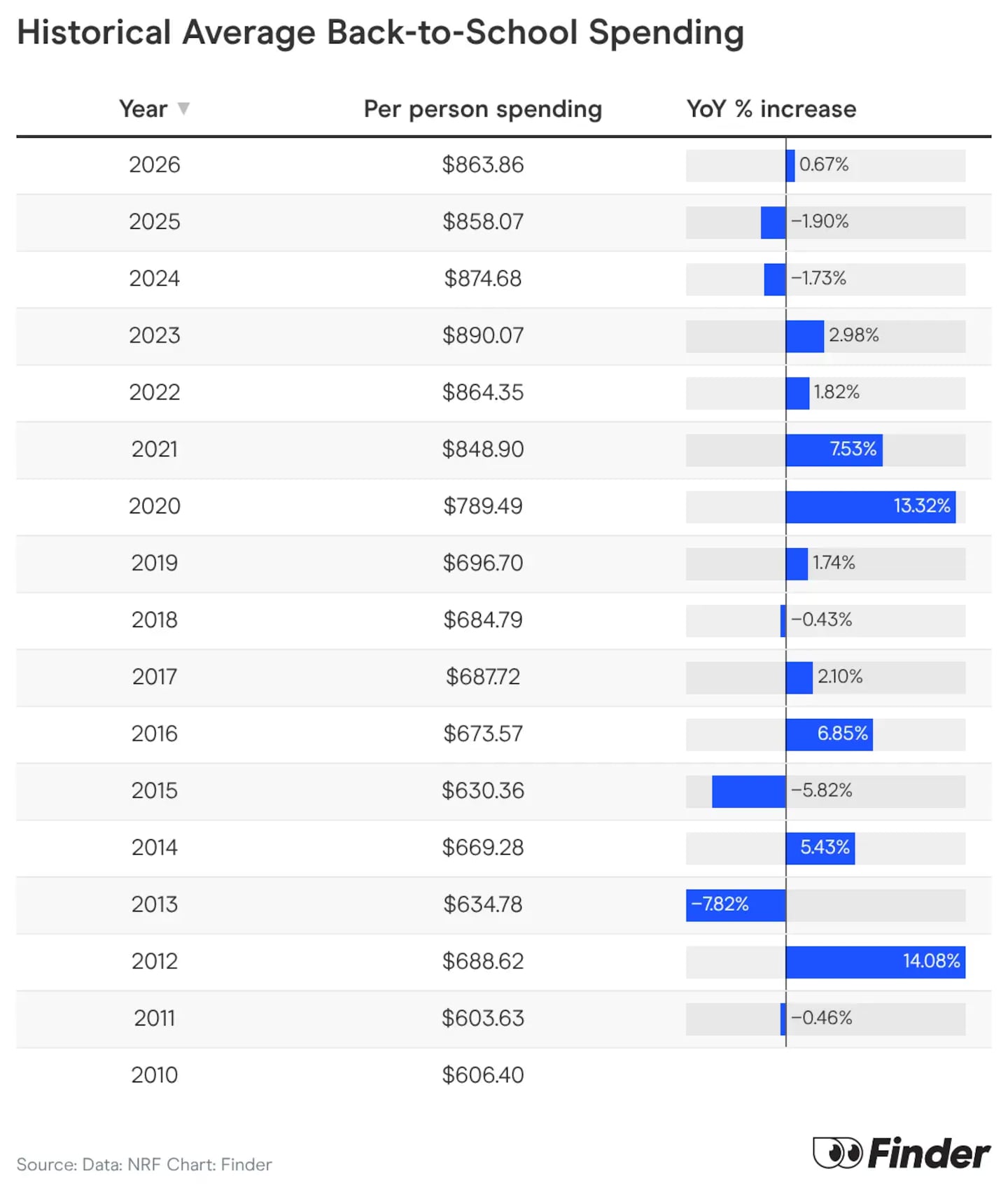
Finder
The NRF also estimates that total spending for K-12 school shopping will be around $43.3 billion this year. According to the federation, this is a new record.
Story continues below Trending Shorts
What’s costing parents more money?
The NRF breaks down elementary school shopping into four categories: electronics, clothing and accessories, shoes, and school supplies.
Shoes saw the biggest per-person spending increase, while families once again spent the most per person on electronics.
Electronics come in at $293.11 per student for 2026. But looking at last year, that's a slight decrease from $295.81. The cost of new shoes rose to $174.01 per family in 2026, compared to last year's figure of $169.13 — that's about a 2.9% increase.
Another rising cost is typical school supplies, like folders, pencils and backpacks, rising from $143.77 to $146.45. This is roughly a 1.9% bump.
Families clearly feel these spending hikes, even when the year-over-year numbers look like tiny increases on a spreadsheet. From the shoppers themselves, 64% told the NRF they expect to see higher prices this year, and they’re not wrong.
Planning ahead for next year
The NRF found 62% of shoppers had already started buying school items by early July, though that’s actually down from 67% last year. Nearly half (46%) of those who have yet to purchase at least half of their back-to-school items say they’re deliberately waiting for the best deals before finishing their shopping.
Want to be an early bird next year? Then consider making a sinking fund. A sinking fund is money you've saved for a purchase or expense you know will happen, which can include school shopping, holiday season shopping or even a vacation fund.
With the average $863.86 per family cost in 2026, there’s a good chance the 2027 figure will be about the same. Knowing the average cost means you can create a sinking fund goal of around $800, and save for that throughout the year.
Different ways to save $800 in 12 months include:
- $66.67/month
- $30.77/biweekly
- $2.19/daily
How to save money on school shopping in 2026
From a financial and parent perspective, here are some recommendations that could help weaken the blow from back-to-school shopping:
- Shop carefully at the start. To avoid buying the wrong things, consider getting basics first (folders, pencils, shoes, etc.) and then waiting for the teacher's full list before filling in the gaps. For example, the school may say that spiral notebooks are required, but then the teacher may require composition notebooks instead.
- Cash-back programs. Got any unused cash-back rewards sitting around? Now might be the time to use them. And if you're good with credit cards, then using cash-back programs to stock up on points makes a lot of sense, too, especially on big-ticket items.
- 529 withdrawals. As of 2026, families can pull up to $20,000 per student per year, tax-free, from a 529 plan to cover K-12 costs. That now includes curriculum materials, textbooks, workbooks, digital learning tools and tutoring (not just tuition). Rules vary by state, so check whether your specific purchases qualify before pulling from your regular budget instead.
- Look through your house. Especially if you have multiple kiddos, comb your house for school supplies you might already have. How's the backpack from last year holding up? Any unopened boxes of crayons or markers lying around?
- Compare prices across stores. Shoppers are splitting purchases across department stores (47%), discount stores (44%) and clothing stores (39%), according to NRF. Comparing prices for electronics or shoes could equal savings, especially since electronics and clothing are where the costs hurt the most.
- Tax credits. If you have a college student you're claiming as a dependent, you could claim tax credits for school shopping, like the American Opportunity Tax Credit worth up to $2,500 per student.
Bottom line
While the cost of back-to-school shopping hasn't skyrocketed from last year, prices are slowly trickling upward. Shoes are the biggest offenders, seeing an increase of about 2.9% in a year.
A little early planning, some hand-me-downs and patience for sales can go a long way toward keeping this year’s back-to-school costs low.
This guide has been edited by Richard Laycock.
This story was produced by Finder and reviewed and distributed by Stacker.
/cloudfront-us-east-1.images.arcpublishing.com/cmg/7QOJU3BNCJERBNKJC5LWTBYFLU.png)


